For Production Studios
Stop Developing Scripts
You Can’t See Clearly
Quanten Arc gives your development team a structural read on every script in the pipeline. Benchmark at intake, commission a full Structural Analysis Report for the shortlist, and take a PDF into the development meeting with something concrete to work from.
Coverage Tells You What. Structure Tells You Where.
The Script Reads Well. The Story Doesn't Hold.
Great scene-level craft can mask a structure that isn't working. Coverage catches dialogue, character voice, and marketability. It doesn't catch the act two with no engine, the climax that peaks too early, or the protagonist who disappears for forty pages.
You're Deep Into a Read Before You Know It's Unfixable.
The structural problems that make a script un-developable are almost always visible in the arc before page forty. A fast structural read before the full development pass saves time, budget, and the difficult conversation that follows.
Notes Without Evidence Don't Give Writers a Target.
'Act two loses energy' is a diagnosis. 'Scenes 54 to 68 are all below 30 intensity with no rising action before the climax' is a location. Writers act on the second kind. The first sends them back to rewrite without knowing where to look.
The Same Read, Every Script, Every Time.
Every script that goes through your team gets the same treatment: scene-by-scene intensity analysis, genre-calibrated benchmarking against 500+ produced films, character presence mapping, pacing breakdown, narrative beat classification. Not one reader’s read on one day. A structural layer that is consistent across your whole slate, comparable across projects, and trackable across drafts.
Live Examples
See How Different Stories Are Structured
Scene-by-scene intensity, act structure, and trend line for films already in the benchmark library. This is what every script in your pipeline receives.
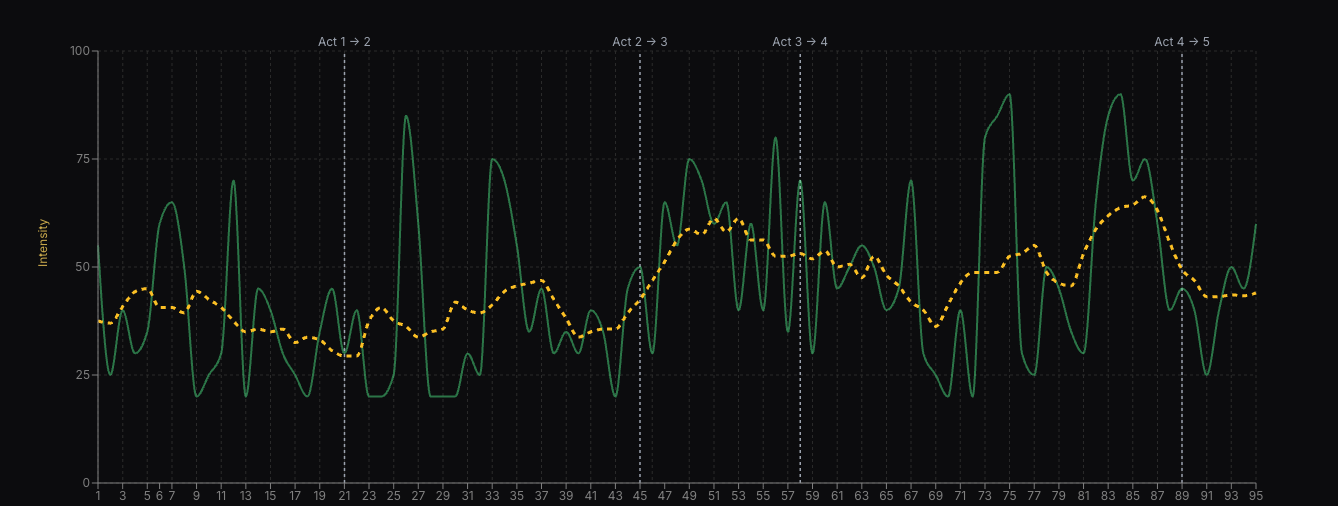
Every story that holds an audience has an intentional shape. This is what Arc maps, measures, and benchmarks.
Open Examples
See a Full Analysis
Three complete Arc analyses, open to anyone. Every chart, every scene, every beat, no sign-in required.
What the Studio Plan Includes
Everything a development team needs to evaluate scripts with a shared structural language.
Structural Analysis Reports
Archetype classification, framework alignment, beat-by-beat shaping guidance, pacing verdict, comparable titles from the benchmark library. Formatted as a PDF, ready for the development meeting. 10 credits per report.
Five Seats, One Credit Pool
All five team seats draw from the same credit pool. Development executives, story editors, creative producers: everyone works from the same structural data without credit friction or per-seat allocation.
50 Credits Per Month, Rolling Over
Benchmark a script for 1 credit. Run a full Structural Analysis Report for 10. Credits accumulate in quiet months and carry into busy ones. Top up at $99 for 10 when the pipeline demands it.
Benchmarked Against 500+ Films
Every script positioned against the public library of 500+ produced films, calibrated by genre. Drama against drama. Thriller against thriller. Your script's arc measured against the structural shape of films that have held audiences.
Character Presence Mapping
Scene-level character tracking across every script. Where does the protagonist disappear? Which act is dominated by supporting roles? Structural imbalances visible before more development budget goes in.
Beat Classification, Scene by Scene
Every scene classified by emotional function: where tension builds, releases, pivots. The beat map is included in every benchmark and in the Structural Analysis Report.
From Submission to Development Meeting
Read the Arc First
Benchmark every incoming script for 1 credit before the development read. Arc, pacing, character presence, genre comparison. Know whether it's worth reading deeply before you commit the time.
Run Reports on the Shortlist
For the scripts that warrant attention, commission a full Structural Analysis Report. 10 credits: archetype, framework alignment, beat shaping, pacing verdict, PDF.
Take It Into the Room
The PDF goes directly into the development meeting. Beat-level shaping notes, framework targets, comparable titles the writer will recognise. The conversation has a foundation.
Confirm the Notes Landed
When the revised draft arrives, benchmark it again. See exactly what moved and what didn't. Know whether the structural notes landed before you commission another pass.
Who Uses It
Development Executives
Benchmark the slate at intake. Run full reports on the shortlist. Arrive at the development meeting with data, not just a read.
Story Editors
Give writers precise structural targets from the Structural Analysis Report. See whether the next draft is moving in the right direction before you read a page.
Creative Producers
Compare archetype, framework alignment, and arc shape across the whole pipeline. Know which projects are structurally ready and which need another pass before more resources go in.
Where It Goes in the Workflow
Slate Triage
Run a benchmark on every submission before the full read. 1 credit per script, instant structural signal. The scripts worth developing will show it in the arc. The ones that aren't will show that too.
Development Meetings
Commission a Structural Analysis Report on your shortlist before the development meeting. Archetype, framework alignment, beat shaping guidance, comparable titles. The conversation stops being about whether the structure works and starts being about how to fix it.
Draft Tracking
Submit each new draft for a benchmark. See how structure has shifted between versions before you read a word. Confirm the notes landed, or know immediately that another pass is needed.
Studio DNA
Upload scripts from your produced slate as a private library. Benchmark incoming scripts against your own hits alongside the public 500+. Your editorial voice becomes a structural reference, not just institutional memory.
Private Slate Library
Your Hits, Your Benchmark
The public benchmark library gives you a structural read against the industry. Your private slate library gives you something more valuable: a read against your own produced work.
Upload scripts from your own films. They stay private, visible only to your team. Quanten Arc analyses them the same way it analyses everything else, then layers them into your workspace alongside the public library.
Now incoming scripts can be benchmarked not just against 500+ industry films, but against the films your studio has made. The structural patterns behind your greenlight decisions become a living reference that every new project is measured against.
01
Upload your produced slate privately
Add scripts from films you have made. They never appear in the public benchmark and are never visible outside your team.
02
See what your hits have in common
Compare structural arcs across your produced slate. The intensity patterns, act shapes, and pacing rhythms that define your editorial voice become visible data.
03
Give development partners a precise target
Share workspace access with the writers, producers, and development executives you are working with. They can see exactly what your slate looks like structurally, and position their work accordingly.
This is not just a tool for evaluating incoming scripts. It is a way to encode your studio’s editorial voice into something you can share, measure against, and build on. The structural fingerprint of what you greenlight, owned by you.
Studio Plans
Designed for teams evaluating scripts at scale.
Studio
Pricing discussed on call
- ✓5 team seats, credits pooled across all seats
- ✓50 credits/month, shared across team
- ✓Benchmark any script - one by one or in bulk
- ✓Full Structural Analysis Report
- ✓Credits roll over month-to-month
- ✓Top up credits at $99 per 10
- ✓Shared team workspace and admin controls
- ✓Priority processing queue
- ✓Dedicated support channel
Enterprise
Coming Q3 2026
- ✓Everything in Studio
- ✓Unlimited team seats
- ✓Custom integrations
- ✓Dedicated account manager
- ✓SLA guarantees
Explorer and Creator plans are available now for individual development executives wanting to start immediately. View all plans →
Frequently Asked Questions
How does Quanten Arc fit into an existing development workflow?
Quanten Arc sits alongside your existing coverage process, not in place of it. Coverage gives you craft, voice, and marketability. Quanten Arc gives you structure: the same scene-by-scene intensity analysis, genre benchmark, and character presence mapping for every script, regardless of who submitted it or when. The two complement each other. Coverage is subjective by design. Structural analysis is not.
Can multiple team members access the same analysis results?
Yes. The Studio plan includes a shared workspace where all analyses are visible to your full development team. There is no need to export and distribute coverage separately; the structural data is accessible to everyone on the account.
How does the Studio plan differ from Creator?
Creator is designed for individual writers and producers. Studio is designed for development teams: it includes five team seats, a shared workspace, higher monthly credit volume, priority processing, and a dedicated support contact who understands your workflow.
What is a credit, and how are they consumed?
Credits are the currency for Studio plan usage. Benchmarking a script costs 1 credit: you get a full structural arc, genre comparison, pacing, and character analysis. Running a Structural Analysis Report costs 10 credits: you additionally get archetype classification, framework alignment, beat-by-beat shaping guidance, and a PDF. Credits are shared across all five team seats and roll over month to month. Unused credits do not expire while your subscription is active.
What happens in a heavy development month?
You can top up credits at $99 for 10 credits, any time. In quieter months, unused credits accumulate. The math: 50 credits at the top-up rate would cost $495. The Studio plan gives you the same credits plus team infrastructure, shared workspace, and priority processing.
Can we build a private benchmark library from our own produced films?
Yes. Studio accounts can upload scripts from their own produced slate as a private library. These are analysed the same way as everything else but are never included in the public benchmark and remain visible only to your team. Incoming scripts can then be compared against your private slate alongside the public library, giving you a structural read against your own editorial voice, not just the industry average. Development partners you share the workspace with can also use this as a reference.
How does Quanten Arc handle script confidentiality for studio submissions?
Submitted screenplays are deleted from our servers immediately after analysis is complete. We retain only the structural arc data: intensity scores, act markers, and benchmark comparisons. No readable screenplay content is stored at any point. Scene summaries used in the visualisation are also deleted when you delete an analysis.
Which genres does the benchmark library cover?
The library currently includes drama, thriller, horror, romantic comedy, science fiction, and action, with new titles added regularly. Genre benchmarking compares your script against produced films in the same genre specifically, not against a generic structural model.
How is Quanten Arc different from traditional script coverage?
Script coverage is subjective: it reflects one reader's response on one day. Structural analysis is objective and repeatable: the same script submitted twice produces the same arc data. The two complement each other. Coverage gives you craft and marketability notes; structural analysis gives you a consistent data layer across your full slate.
What does the Enterprise plan include?
Enterprise is designed for larger organisations and is available at custom pricing. It includes unlimited seats, evaluation mode with detailed structural feedback reports, custom integrations with your existing script tracking or development tools, SLA guarantees, and a dedicated account manager. Contact us to discuss requirements.
Your Scripts Stay Private
Submitted screenplays are deleted from our servers immediately after analysis. We retain only the structural arc data. No readable script content is stored.
Fair Use & Benchmarks
Our benchmark library is built on published screenplays analysed under fair use. We don’t store or redistribute third-party scripts.
Full Data Export
Export your entire workspace as a standard JSON file at any time. Every arc, beat label, scene breakdown, and archetype result is yours. No lock-in.
Who We Are
Built by Quanten Media
Quanten Media is a content intelligence company. We build tools that give filmmakers, writers, and studios an objective structural view of their stories. Quanten Arc is our flagship product: a scene-by-scene intensity analysis platform calibrated against real audience response data and benchmarked against 500+ professionally analysed screenplays, so development teams can evaluate structure before a single frame is shot.
We work with independent filmmakers and production companies who want data in the room when creative decisions are made.
About Quanten Media →